

DGP Anjani Kumar Delivers Insightful Address at 4th Oration on Prof. S. Venugopal Rao's Birth Centenary
DGP Anjani Kumar Delivers Insightful Address at 4th Oration on Prof. S. Venugopal Rao's Birth Centenary
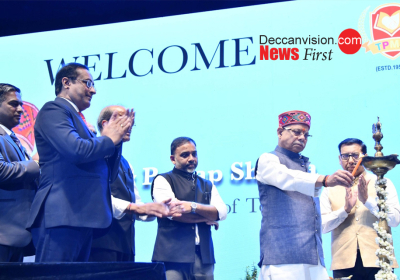
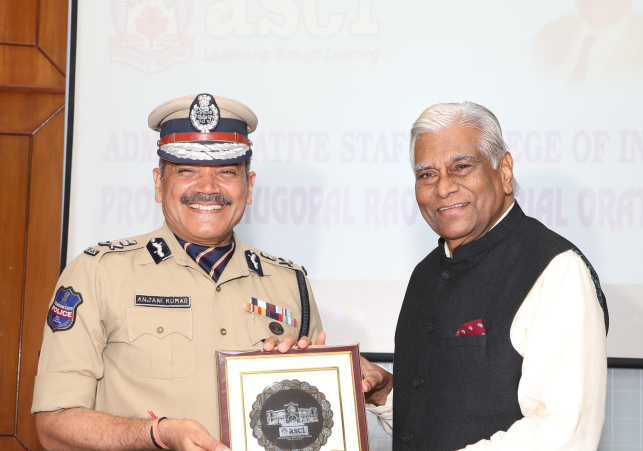
Hyderabad, Telangana: 22.09.2023. The 4th Oration on the Birth Centenary of Prof. S. Venugopal Rao witnessed a captivating speech by Sri Anjani Kumar, IPS, Director General of Police, Telangana State. The event, held at ASCI, Hyderabad was graced by the presence of esteemed participants, including Sri K. Padmanabaiah, Chairman of the Forum for Good Governance, Sri Rajini Kanth Suret, Member of Prof. S.Venugopal Rao Memorial Charitable Trust, Mr. Gareth, Brtish Dy.High Commisioner for TS & AP, Mr. Sri Kamal Kumar, IPS (Retd.), M.M. Bhagawat, IPS, Mr.Santosh Mehra,IPS (Retd.), Mr. Murali Krishna, IPS (Retd.) and other distinguished guests. This significant gathering was organized by the Prof S.Venugopal Rao Memorial Charitable Trust
The Central theme of the oration was "Policing in the Changing Society: Challenges at Various Levels."
In his opening remarks, Sri K. Padmanabaiah commended the exemplary tenure of Sri Anjani Kumar, IPS, as Hyderabad's Police Commissioner, describing his work as of the highest order. He also proudly acknowledged Telangana Police's standing as one of the country's finest Police forces and expressed his delight in having Sri Anjani Kumar the Guest.
Sri Anjani Kumar began his address by sharing his lifelong fascination with the thirthankars of Jainism, drawing parallels between Prof. S.Venugopal Rao and Sri K.Padmanabaiah, whom he likened to thirthankars of the bureaucracy. He praised their extensive experience and their unwavering commitment to guiding society through the challenges it faces.
Reflecting on his own journey, Sri Anjani Kumar shared his experiences as an ASP during his training, highlighting the significant changes and progress he has witnessed in law enforcement from his initial days in service to the present. He emphasized the pivotal role played by senior officers in shaping the success of their department, underscoring the importance of collaboration.
Sri Anjani Kumar then explored the challenges presented by rapidly changing environments across various sectors and organizations. He began by referencing a physics textbook from 1945, which had asserted that mankind could not develop a rocket capable of carrying a payload to the moon. However, within just 25 years, this statement was proven wrong, as not only payloads but human beings were sent to the moon.
Transitioning to law enforcement, he shared insights from his postings in regions heavily affected by left-wing extremism/naxalism, highlighting the evolving nature of crime. He explained that as societies transitioned from being food gatherers to food producers, crime also transformed, shifting from petty theft and quarrels to more complex crimes driven by trades and exchanges, often involving collaborations and conspiracies.
Sri Anjani Kumar emphasized the evolution of policing, from traditional cycle patrols to the challenges posed by modern cyber patrols. He also delved into the complexities of jurisdiction defined by the Indian Penal Code for reporting, investigating and trying crimes. He noted the unique challenges arising from the borderless nature of cybercrimes, citing examples of hackers from distant regions targeting computers in India and beyond.
Furthermore, Sri Anjani Kumar highlighted the need for preparedness within policing systems and the entire criminal justice system. He cited prominent cases, including the stock manipulation scam of Harshad Mehta and Abdul Kareem Telgi's Stamp Papers scam, as instances where shortcomings needed addressing. He stressed the importance of internal correction when problems arise within the system, referencing the DK Basu judgment of the Supreme Court and the recent Avnesh Kumar judgment.
Sri Anjani Kumar discussed issues of separate identity fueling regional animosity, citing the reservation issue between the Meitei and Kookie communities in Manipur. He further emphasized incidents such as the 2007 bomb blast in Ludhiana, involving 5 kgs of RDX and the 2008 Mumbai attacks, the first international terrorist incident in India, which claimed the lives of people from various parts of the world. He underscored the increasing use of technology by terrorists and the challenges of social media monitoring by criminal and terror groups.
Shifting focus to border challenges, he highlighted coastal security's major impact in India, given the extensive coastline, including borders with Bangladesh, Nepal, Bhutan, and Myanmar. Additionally, he touched upon infrastructure vulnerabilities, real-life examples of critical infrastructure damage, cyber security threats, unnoticed data breaches, IoT vulnerabilities, drone risks, prison management and human trafficking.
Sri Anjani Kumar emphasized the importance of public awareness and education campaigns in addressing these challenges. He encouraged critical thinking and effective leadership in managing fear and anxiety, particularly in the age of social media amplification.